2026
Nectandra Institute
On Nov 25, 2025, our non-profit Nectandra Insitute (NI) board of directors voted to cease field operations in Costa Rica as of March 31, 2026, and in the US, as of Dec 31, 2026. For the last 25 years, NI worked with local water management associations (ASADAS) in the Balsa watershed to buy cleared land using NI’s interest-free eco-loans, in exchange for the ASADAS’ commitment to restore the land into native cloud forest on their time and labor. In rural areas of Costa Rica, the government does not supply potable water. Rural communities supply and manage their own water, mostly through springs, which are fed from rainwater collected and filtered through watershed land.
NI’s eco-loan program was initiated as a proof-of–concept experiment to test if forest restoration can be accomplished at the grass root level. The results are in: this twenty-five year experiment is an unqualified success. Every one of 15 land-purchase loans has been paid on time and without default. They had a great impact in the region and were the envy of other watershed rural water managers. Our region is now among the top in the country in density of privately owned, watershed properties. The approach had entered the region’s mindset and had spread. Two de novo eco-loan funds, initiated by the communities themselves, have sprouted with NI help. All the while, NI gained friends and invaluable good will. These derivative eco-loan funds will continue to promote future restoration of cloud forest beyond the life of the Institute.
After 25 years, with the documented positive and high impact results, eco-loans can now be taken off the proof-of-concept list and added to the tool chest for cloud forest conservation.
Nectandra Reserve Forms Alliance with COTERC (Canadian Organization for Tropical Education and Rainforest Conservation)
After NI’s closure, the separately operated Nectandra Cloud Forest Reserve will continue its operation, but in alliance with COTERC, a Canadian organization that has operated a biological research station, for 36 years, on the Atlantic coast of Costa Rica in Tortuguero. Its main focus is on scientific investigations on tropical fauna and flora and field research training for students from abroad.
The Nectandra Reserve will maintain its naturalist-guided day tours and conservation-themed events.
2023
It’s been quite a year for Nectandra Institute’s education and communal outreach programs.
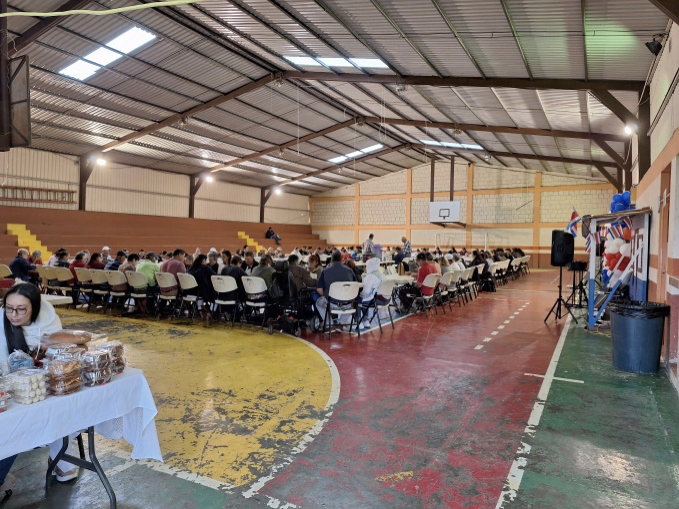
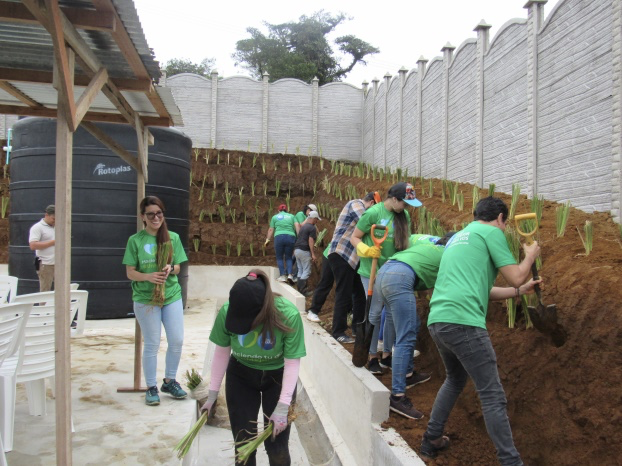
At the formal part of the 15th annual celebration of the New Culture of Water Month (above), members of more than a dozen communities and water associations with Nectrandra Institute’s ecoloans attended the presentations.
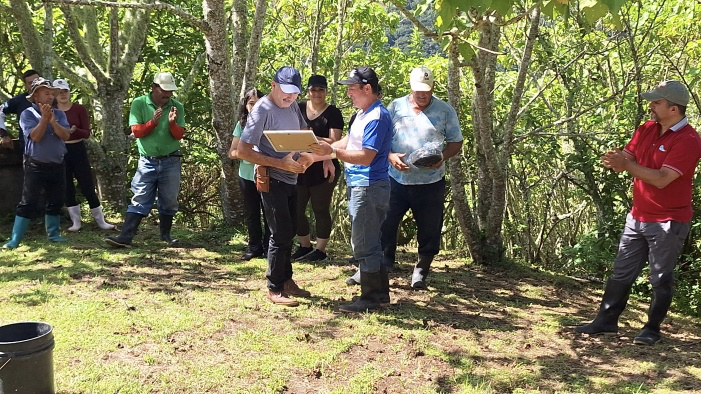
It was followed by the tree transplantation session at the first Eco-loan property of Angeles Norte, now in its 15th year of reforestation.
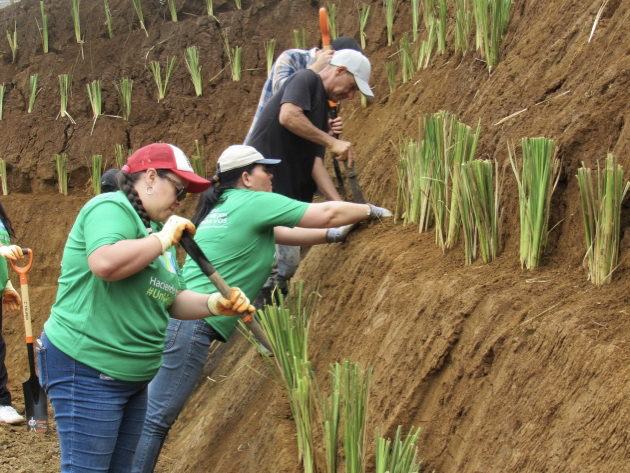
Below. Volunteers were preparing a new site for large water tank to service the community of Angeles Norte. They are planting Chrysopogon zizanioides, a grass and member of the sorghum family. Its long (≥4 m, 12ft) exclusively downward roots makes it ideal for controlling soil erosion and stabilizing steep banks.
Recent Sightings
The greatest joy in living in the cloud forest is the unceasing parade of new faunal or floral encounters. For example, though supposedly common, the sheep frog in the photo below was seen at Nectandra for the first time this year. It hides and lives underground in burrows, feeding on subterranean ants or termites, emerging after dark only during mating season. It surfaced from its deep burrows this year after days of torrential rain.
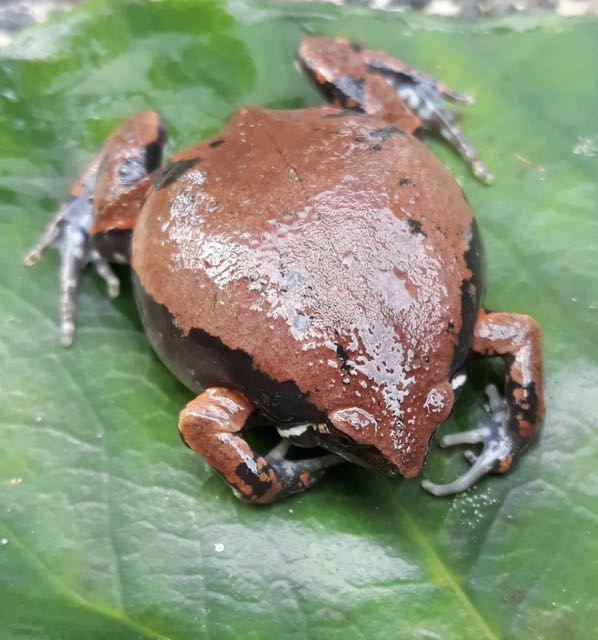
Photo - Hypopachys variolosus, body inflated in a defensive position while it was being photographed.
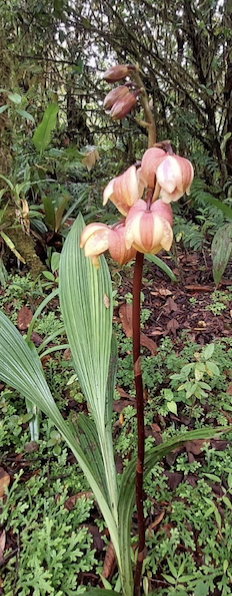
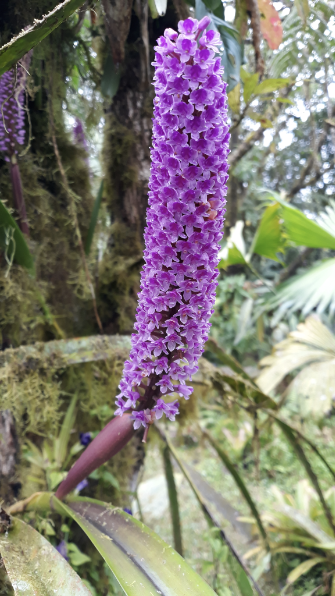
Two orchids were among the “new” to Nectandra sightings in 2023. For whatever reasons, they only bloomed this year for the first time in decades, rendering them finally visible. Our garden staff must have walked by these plants thousands of time during this period.
Photo left – Orchid Warrea costaricensis
Photo right – Orchid Arpophyllum giganteum
Jan 2022
As in the rest of the world, Covid-19 shut down our Nectandra public operations completely as of March 2020. From the start, Costa Rica issued clear and firm mandates for all to lockdown, to set curfew and driving restrictions, to socially distance and wear masks at all public places. As new information became available, restrictions were gradually withdrawn, one step at a time. Limited businesses hours and driving were gradually allowed to resume but under restrictions, even after vaccination began. Currently, masking and social distancing in public places are still in place. School only opened two weeks ago.
With wide distancing among them, our ground crew at the Reserve resumed full time field and outdoor work, but fully masked as of May 2020. We stepped up our patrolling due to the increasing presence of poachers, who now had more time on their hands to pursue their illegal deeds, and took the opportunity to repair and maintain our fences, trails, and buildings.
At the same time, our Nectandra Institute office staff began to engage with the communities virtually, and resumed their contact work and held conferences from home. Outdoor work at the nursery also resumed. However, many activities could not.
For the past first 12 of 18 months, we canceled:
As of April 2021, our naturalist guides received full vaccinations. The garden guided tours have resumed as of May 2021. In the meantime, our office staff is still working from home, but is able to hold virtual meetings with our community partners. Vaccination in Costa Rica is now available to adults 20 or older. We expect to gradually return to “normal” schedule when our staff is fully vaccinated.
Mar 2021
To commemorate Día Internacional del Agua (International Water Day), Manrique Esquivel from our staff posted a short video to celebrate the critical role of water to life on earth.
While water covers 70% of the earthrsquos surface, only 2.5% is fresh water. Of that, only a fraction is accessible while the rest is locked up in glaciers and snow. In total, just 0.007% of the planetrsquos water is available for human consumption. While the volume of drinkable water has remained static, total human population is now 6.8 billion and growing. In spite of waterrsquos importance to our life and health, at the present rate and usage, only one in three persons on our planet will have access to adequate potable water by 2025.
Potable water distribution in Costa Rica is largely managed by the federal Institute of Water and Sewers (AyA). In many of the countryrsquos rural watersheds, potable water management is distributed by some 1500 semi-autonomous volunteer water management associations.


 June 2026